Thinking Ahead Blog


May 03, 2017
Discover the story of Farfetch, the only Portuguese unicorn startup, and how this company connects the physical and virtual worlds in an omnichannel experience.
TweetThe only Portuguese unicorn startup, valued at more than one billion dollars, presented the Store of the Future in March 2017. Discover how Farfetch, a luxury fashion eCommerce company, integrates the physical and digital worlds, setting an example for companies in every sector.
In October 2007, José Neves, founder and CEO of Farfetch, had two companies in different sectors: one in programming and the other in footwear. During a fashion fair in Paris, the Portuguese entrepreneur realised that the only brands achieving good sales results were those with online sales channels. And so came the "Eureka!" moment. "If we could put all these stores with luxury pieces on a virtual platform, we would give consumers the emotional side of travelling through the world of fashion", says the founder of Farfetch.
A year later, Farfetch was born. The idea is seemingly simple: to create an online bridge between consumers and stores, regardless of their location. For example, a customer in Lisbon can easily buy a luxury garment in Hong Kong and receive the order at home. Farfetch handles the whole process.
Farfetch currently ships fashion products from more than 750 designers and partner boutiques on the platform worldwide, to more than 170 countries.
The company divides the fashion brands on the site into two shopping categories: LUXE, the luxury brands offering high-end products, and LAB brands, which include emerging and experimental brands. A third department (contemporary), with more casual, everyday pieces, was consolidated within the LAB category to make browsing the site easier and more intuitive for the consumer.
Farfetch's biggest sales come from luxury brands such as Valentino, Saint Laurent, Givenchy and Comme des Garçons, but emerging and lesser-known designers are the company's key differentiator. According to Stephanie Horton, Farfetch's Chief Marketing Officer, Farfetch's positioning is always ahead thanks to its product diversity, which "helps Farfetch reach a broad and diverse range of consumers."
In addition to the website, Farfetch also has an app compatible with iPhone and Android, "Farfetch Discover", which allows consumers to buy luxury pieces from their smartphone, as well as access "travel guides to some of the most stylish and cosmopolitan cities in the world, such as New York, Paris, Milan, Rome or Los Angeles".
Despite the positive trend in sales of luxury brands through E-Commerce platforms, only 7% of these purchases are made online, a figure expected to reach 25% in 2025. However, despite this growth, most sales in this sector are still made in physical stores.
To get around this challenge, Farfetch will open the first "Store of the Future" at the end of 2017, having chosen the iconic Browns in London as the first location. This store will blend the online and offline worlds, offering a personalised shopping experience based on the collection of customer data. According to Farfetch, the "Store of the Future" aims to "demonstrate how technology can be seamlessly woven into the customer experience, offering a competitive advantage for retailers and brands".
The "Store of the Future" was built on three principles:
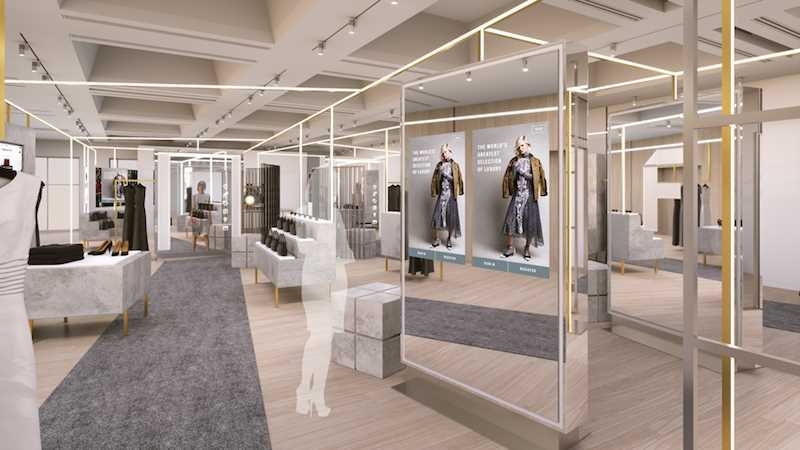
To achieve this last principle, Farfetch's software includes a universal login, which allows a digital mirror to retrieve information from the online database and show items from a given customer's account wish list. It will also be possible, through offline cookies, to know much more about the consumer, such as how long they spent in the store, which items they tried on or their preferred payment methods, closing the loop between the online and offline worlds and creating "a true single view of the customer".
Using RFID technology, Farfetch can detect when a customer approaches and touches an item. It can then have that item added to a personalised list in the customer's online account or taken to the fitting rooms. It will also be possible to pay in the middle of the store using a mobile phone.
Another innovation presented by the company, at the same conference where it presented the "Store of the Future", was "Store to Door in 90 Minutes", which will allow customers to buy selected Gucci pieces through the website or app and receive their orders within 90 minutes in London, New York, Dubai, Los Angeles, Madrid, Milan, Paris, São Paulo, Miami and Tokyo.
The e-commerce platform sells to 190 countries and has offices in London, Porto, Guimarães, Lisbon, New York, Los Angeles, São Paulo, Tokyo, Hong Kong, Shanghai and Moscow, with a team of almost 1,500 employees. Although the company is headquartered in London, it is in Matosinhos that the entire development team, financial services and account managers for partner stores are based, as well as part of customer service. All the items available on the site are photographed and catalogued in another company building in Guimarães. In 2016, according to figures released by the company, Farfetch grew by 70% and closed the year with gross sales of 800 million dollars, recording around 10 million visits to the site per month, with customers spending an average of 700 dollars per order.
The company is the only one in Portugal to be considered a unicorn, a name given to startups valued at more than one billion dollars. This was helped by the more than 300 million dollars (270 million euros) raised in six investment rounds.

Written by:
Openlimits

Reporting your inventory to the Portuguese Tax Authority (AT) is a legal obligation and must be done by 30 January.
Know more >When inventory is not integrated, up to date and visible, companies lose much more than margin - they lose predictability, efficiency and responsiveness.
Know more >
We are very proud that Openlimits has received the SME EXCELLENCE (PME EXCELÊNCIA) award, alongside companies that are making the Coimbra Metropolitan Region an increasingly dynamic and competitive area.
Know more >
We are delighted to announce that Openlimits is now a Cegid Partner Gold in Portugal.
Know more >
Rua Princesa Cindazunda, nº. 55, Lote 16.6, Loja nº. 4
3030-503 Coimbra - PORTUGAL
tlf.: +351 239 940 150 (call to the Portuguese national landline network)
e.: geral@openlimits.pt
PORTUGAL | ANGOLA