Thinking Ahead Blog


September 12, 2019
Understand what AI (Artificial Intelligence) and Machine Learning tools are and why it is important to use them when interacting with your customers.
TweetNowadays, the concepts of Artificial Intelligence (AI) and Machine Learning leave no one indifferent, regardless of their level of knowledge or involvement, and you have almost certainly heard of them for one reason or another.
Digital transformation has brought companies new ways of managing and driving their business through approaches capable of offering customers greater and better experiences, such as Artificial Intelligence and Machine Learning.
In customer service, for example, AI can be used to create automated responses that interpret users' questions logically and thus provide appropriate answers from a previously defined knowledge base. These responses rely on Machine Learning, which is responsible for combining all the historical data in the system. The information is retained and delivered as personalised content, tailoring the answers to customers' service needs.
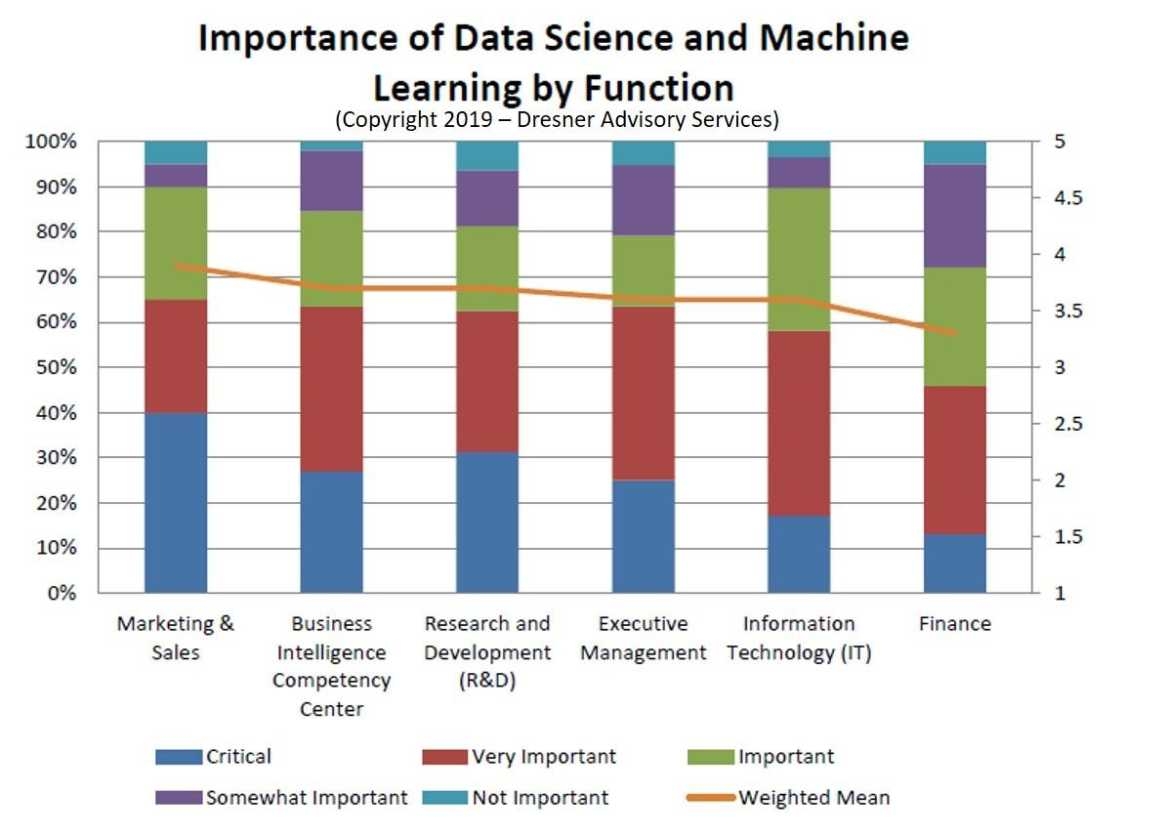
According to the consultancy Dresner Advisor Services, 40% of Marketing and Sales teams see Artificial Intelligence and Machine Learning as fundamental tools for the success of their business actions and strategies. As the chart below shows, these teams are the ones that consider these technologies most important for achieving their growth targets.
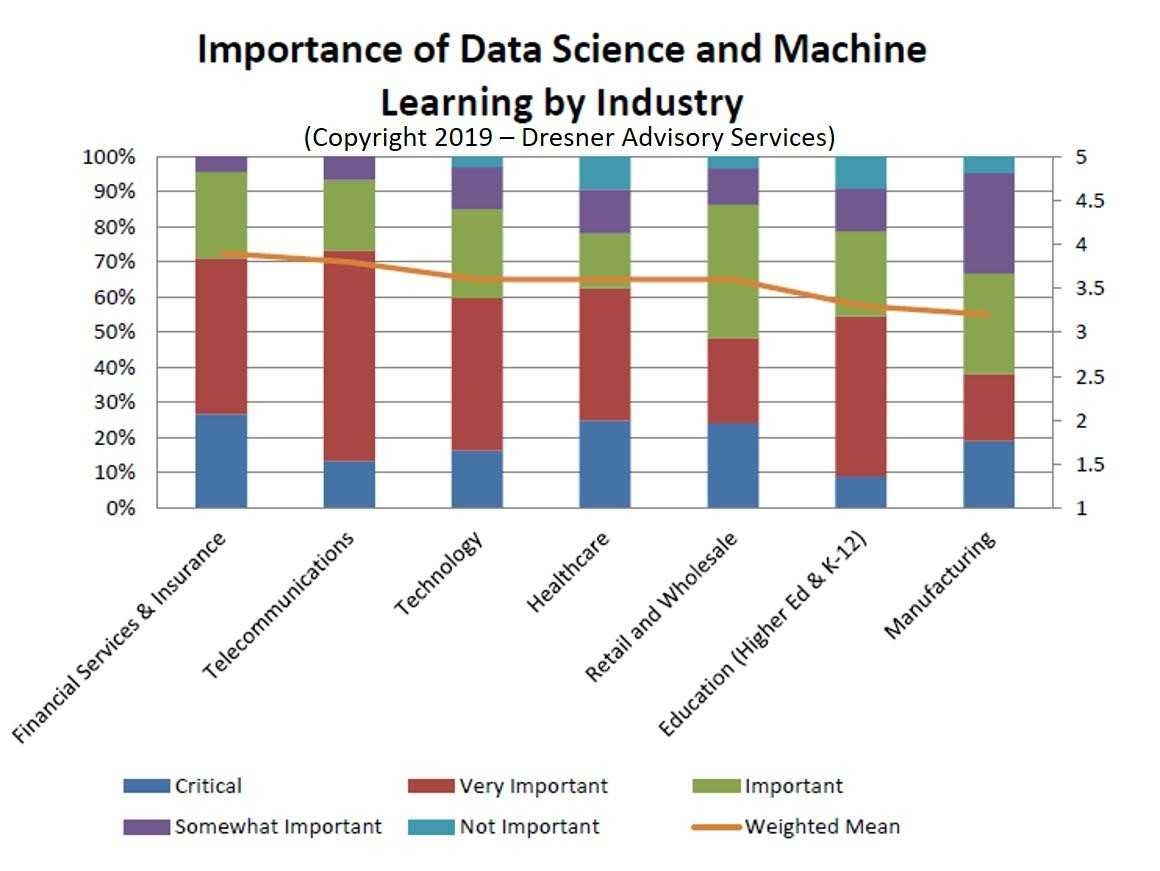
According to the same consultancy, financial and insurance services, healthcare and retail are the sectors that attach the most importance to Machine Learning and Data Science tools, considering them fundamental to the growth and success of their sector.
We can therefore see that the two technologies are interlinked and complement each other, but what exactly are they and how can they be used effectively in business?
AI is the ability of a machine, controlled by a computer, to think, learn, decide, carry out tasks and solve problems intelligently. This technology can be seen as a simulator of human reasoning and can therefore be applied in a wide range of sectors, such as healthcare, entertainment, telecommunications and retail. Within AI there are several subsets of technologies that aim to use machines to simulate human tasks, such as cognitive computing, computer vision and Machine Learning: a data analysis method that automates the building of analytical models, based on the idea that systems can learn from data, identify patterns and make almost rational decisions.
Artificial intelligence is important in business because it helps managers identify opportunities by reading and interpreting data that is often confusing and disorganised. This is not the only advantage: in business these tools can be applied in many ways, the most relevant being contact between the brand and the customer.
This trend has been growing in recent years, in order to provide a faster, more practical and more intuitive user experience. This type of service is directly connected to other applications, such as Facebook or Messenger. This interaction can also take place through voice commands, using tools such as Apple's Siri or Amazon's Alexa.
It is increasingly proven that creating innovative and personalised experiences helps to convert customers. With Machine Learning it is possible to personalise not only experiences but also the communication we have with different consumer profiles. One excellent example is Spotify, which every week releases a personalised playlist for each user based on their interactions with the platform.
Have you ever thought about how technology helps us complete tasks more quickly, effectively and cheaply? As well as helping businesses automate certain tasks and processes, artificial intelligence through Machine Learning speeds up results, eliminates human error and helps optimise the lead conversion process.
The great advantage of artificial intelligence is its ability to detect behavioural patterns by interpreting data. Through Machine and Deep Learning it is possible to predict other patterns and even future interactions and situations with customers.
The relationship between customers and companies is one of the pillars underpinning the importance of digital transformation in business, and artificial intelligence works precisely in this direction. As mentioned above, the main objectives are not only to increase customer satisfaction, but also to make interaction between companies and customers, and their management strategies, easier. The use of AI in business is therefore synonymous with a better customer experience and, consequently, more Sales.

Written by:
Openlimits

Reporting your inventory to the Portuguese Tax Authority (AT) is a legal obligation and must be done by 30 January.
Know more >When inventory is not integrated, up to date and visible, companies lose much more than margin - they lose predictability, efficiency and responsiveness.
Know more >
We are very proud that Openlimits has received the SME EXCELLENCE (PME EXCELÊNCIA) award, alongside companies that are making the Coimbra Metropolitan Region an increasingly dynamic and competitive area.
Know more >
We are delighted to announce that Openlimits is now a Cegid Partner Gold in Portugal.
Know more >
Rua Princesa Cindazunda, nº. 55, Lote 16.6, Loja nº. 4
3030-503 Coimbra - PORTUGAL
tlf.: +351 239 940 150 (call to the Portuguese national landline network)
e.: geral@openlimits.pt
PORTUGAL | ANGOLA